CULTURE AND POINT OF VIEW.
I often talk about how living, studying, working, advocating and consuming in 4 different countries and traveling to dozens more has given me an ability to “see things differently.” But what does that exactly mean?
As a colleague once told me,
“discovery is looking at the same thing as everyone else and seeing something different.”
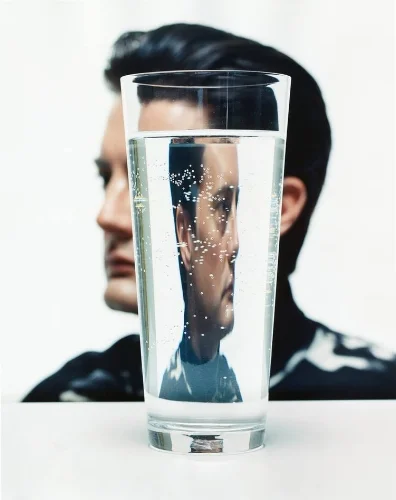
And that is exactly what I mean, and what I myself often experience as a result of being part of different cultures my whole life: discovery. People from different cultures see things differently, and therefore, when placed in other cultures or environments, they are able to discover a new way of looking at things that is different from people in that culture. It is that ability of looking at things from new and different perspectives that empower them to come up with original ideas and solutions, ultimately leading to innovation and creativity. Throughout this paper and through different studies, I will do my best to explain to you how culture and point of view are related, why it matters, and why you too should encourage yourself to "see things differently."
Professors Richard Nisbett and Takahiko Masuda conducted a study in which they presented 20 second animated video vignettes of underwater scenes to Japanese and American participants (see below). Afterwards, participants were asked what they had seen, and the first sentence of each response was categorized.

The results of the study were remarkable. While the Americans mentioned larger, faster-moving, brightly colored objects in the foreground (such as the big fish), the Japanese spoke more about what was going on in the background (for example, the plants or the small frog to the bottom left). In addition, the Japanese spoke twice as often as the Americans about the interdependencies between the objects up front and the objects in the background. As one Japanese woman explained, “I naturally look at all of the items behind and around the large fish to understand what kind of fish they are.”
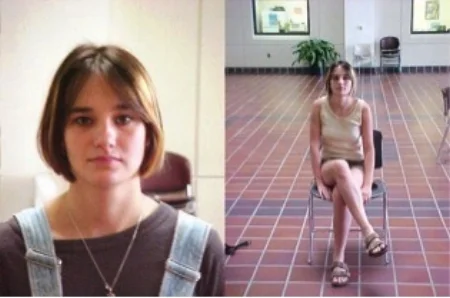
In a second study, Americans and Japanese were asked to “take a photo of a person.” The Americans most frequently took a close-up, showing all features of the person’s face, while the Japanese showed the person in his or her environment instead, with the human figure quite small in relationship to the background (see below).
In a third study, Nisbett and Masuda asked American and Taiwanese students to read narratives and watch videos of silent comedies - for example, a film about the daily life of a woman, during which circumstances conspire to prevent her form getting to work - and then to summarize them. In the summaries, Americans made about 30% more statements referring to the central figures of the stories than their Taiwanese counterparts did.
Notice the common patterns in all 3 studies. The Americans focus on individual figures separate from their environment, while the Asians give more attention to backgrounds and to the links between these backgrounds and the central figure.
When Westerns and Asians discussed these studies, a Western participant said: “But the instructions said to take a photo of a person, and the picture on the left is a photo of a person. The picture on the right is a photo of a room. Why would the Japanese take a photo of a room when they have been asked to take a picture of a person?”
An Asian participant respondent to the Westerner: “The photo on the left is not a photo of a person. It is a close-up of a face. How can I determine anything about the person by looking at it? The photo on the right is a photo of the person, the entire person, including surrounding elements so you can determine something about that person. Why would the Americans take a close-up of a face, which leaves out all of the important details?”
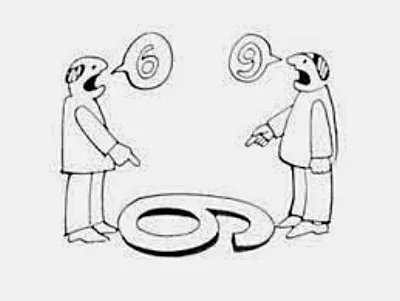
Clearly, Westerns and Asians look at the world very differently. But it’s not surprising that they display these different patterns of interpretation. A common tenet of Western philosophies and religions is that you can remove an item from its environment and analyze it separately. Aristotle, for example, emphasized focusing attention on a salient object. Its properties could then be assessed and the object assigned a category with the goal of finding rules that governed is behavior. He referred to items as each being a separate and isolated object in its own right. Cultural theorists call this specific thinking.
Chinese religions and philosophies, by contrast, have traditionally emphasized interdependencies and interconnectedness. Ancient Chinese thought was holistic, meaning that the Chinese attended to the field in which an object was located, believing that action always occurs in a field of forces that influence the action. Taoism, which influences Buddhism and Confucianism, proposes that the universe works harmoniously, its various elements dependent upon one another. The terms yin and yang (literally “dark” and “night”) describe how seemingly contrary forces are interconnected and interdependent.
With this background in mind, consider the comment another Asian participant gave to the study:
“Chinese people think from macro to micro, whereas Western people think form micro to macro. For example, when writing an address, the Chinese write in sequence of province, city, district, block, gate number. The Westerners just do the opposite - they start with the number of a single house and gradually work their way up to the city and state. In the same way, Chinese put their surname first, whereas the Westerners do it the other way around. And Chinese put the year before month and date. Again, it’s the opposite in the West.”
People from different cultures perceive the world and think about it in very different ways.

"Westerners are inclined to attend to some focal object, analyzing its attributes and categorizing it in an effort to find out what rules govern its behavior. Rules used include formal logic. Causal attributions tend to focus exclusively on the object and are therefore often mistaken.
East Asians are more likely to attend to a broad perceptual and conceptual field, noticing relationships and changes and grouping objects based on family resemblance rather than category membership. Causal attributions emphasize the context. Social factors are likely to be important in directing attention. East Asians live in complex social networks with prescribed role relations. Attention to context is important to effective functioning.
More independent Westerners live in less constraining social worlds and have the luxury of attending to the object and their goals with respect to it. The physical “affordances” of the environment may also influence perception. The built environments of the East are more complex and contain more objects than do those of the West. In addition, artistic products of the East emphasize the field and deemphasize individual objects, including people. Western art renders less of the field and emphasizes individual objects and people.
Perceptual processes are influenced by culture.
In conclusion, Westerners tend to engage in context-independent and analytic perceptual processes by focusing on a salient object independently of its context, whereas Asians tend to engage in context-dependent and holistic perceptual processes by attending to the relationship between the object and the context in which the object is located. And these studies only compare Asians and Westerners, but even people from different Western countries, one same country or one same group have unique ways of thinking that are shaped by their culture and environment.
Participating in different social practices leads to both chronic as well as temporary shifts in perception. These findings establish a dynamic relationship between the cultural context and perceptual processes.

Tanzania (2000), I am the girl in the middle of the picture.
Perception can no longer be regarded as consisting of processes that are universal across all people at all times. Rather, perceptions are shaped by culture and shifted through the different experiences and social practices we engage in. My own life track is evidence to it. Engaging with different cultures and participating in different social practices my entire life has given me an ability to see things from multiple and different perspectives that has an effect on everything I do - in my personal and professional life. It has enabled me to come up with original ideas, to find different solutions, and to be on a constant journey of discovery. And let me tell you, it is far more exciting this way.
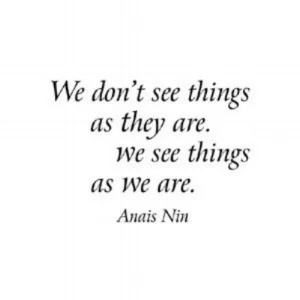
That is why I encourage you to you too be a traveler: to try new things, see new places, meet new people, and look beyond what's in front of you to truly understand the cultures, people and world we live in. Being a traveler broadens your mind, gives you new perspectives on the world, and enables you to experience everyday things as if for the first time. And ultimately you will see that,